Behind the lens

Examining the trend of Glasgow street photography

Street photography has a long history of significance in Glasgow, as it does in many cities worldwide. In Glasgow, the art form has been used to document the city’s history of architecture, intellectual vitality, and cultural vivacity via a simple click. Throughout the decades, a host of Glaswegians have stood in front of the camera’s flash.

Take, for example, the street photography of Thomas Annan, a photographer commissioned by the Glasgow City Improvement Trust to document “slum areas” in Glasgow in 1886, before they were irreparably changed by urban development. His photography series Old Closes and Streets of Glasgow depicts narrow streets in Glasgow’s East End, a historically socially deprived area. These streets are interspersed with washing lines hung between neighbouring buildings, and most strikingly, photos of past Glasgow residents – mothers holding young children, and men captured in moments of stasis, caps dipped on their way to work.

The effects of long exposure photography at the time give the portraits a haunting, ephemeral air. Yet, the air of ghostliness now seems apt; these people and these streets are no longer fixed, living parts of Glasgow, but rather, are now no more than faded Glaswegians in long-since demolished streets, captured forever in a singular moment of existence on Annan’s film.

The effects of long exposure photography at the time give the portraits a haunting, ephemeral air.

Since the 1800s, it is more than just the streets and faces of Glasgow that have changed – street photography has developed dramatically. It is estimated that in 2025, 95% of people in the UK own a mobile phone, meaning the vast majority of us now carry a camera with us wherever we go. As our media has changed from rolls of film to smartphone cameras, and as these cameras have gotten clearer, the ethics around street photography have become more and more blurred.   

Whilst it is legal to take photos and videos of people in public spaces in the UK, it feels as though street photography can impinge on our freedom. Is it ethical to take pictures of people as they go about their business, or is it merely exploitative? Would it be better to only take rehearsed, staged photographs, or does that negate the authenticity that street photography has always craved?

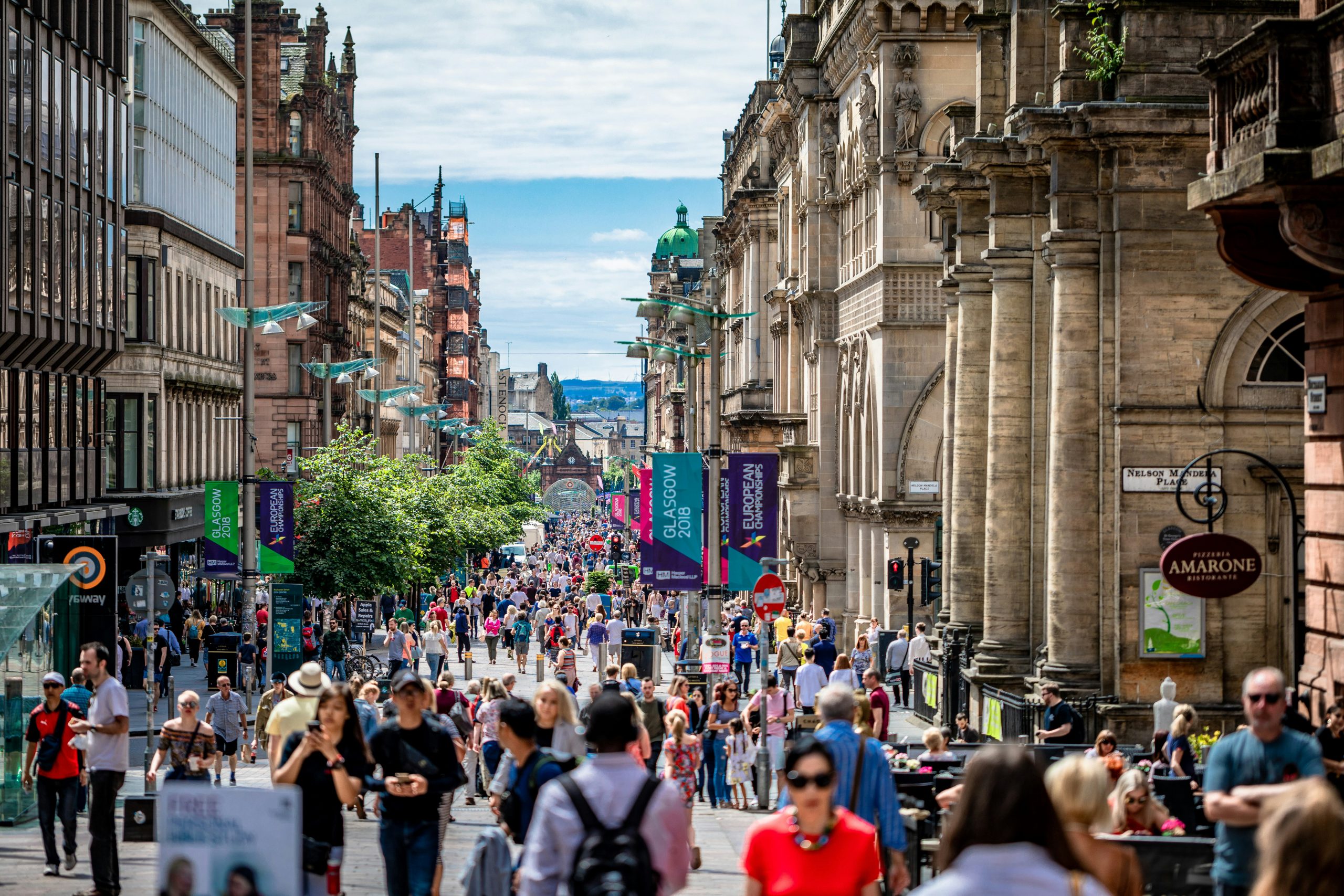
In a world where even walking down Buchanan Street can have you featured in a People of Glasgow TikTok, these questions become more pertinent with every gigabyte of imagery shared online. Whilst street interviews and photography can provide online entertainment, insightful social commentary and documentation, they also raise questions over privacy and personal boundaries, which are often ignored by content-crazed photographers who risk exploiting the public they wish to present.

As well as privacy issues, Glasgow street photography is not immune to social media trends that favour aestheticism above all else.

As well as privacy issues, Glasgow street photography is not immune to social media trends that favour aestheticism above all else. Under slick, curated photo slides of edited images tied together with a perfectly chosen song, commenters argue back and forth over the cherry-picking of “trendy” hotspots. A presentation of the city that predominantly features the West End creates questions over the “gentrification” and “studentification” perpetuated by street photographers.

It could be seen that this trend erodes the history of Glasgow away just as smoothly as the Glaswegian accent is softened to form, what has become known as, the “Glasgow Uni accent.” Does it boil depictions of Glasgow – a city that has historically been recognised for its vast social inequality and its unique working-class culture – down to its “aesthetic” West End, ignoring other sides of the city?

As a Glaswegian friend was keen to remind me, however, these upcoming and trendy places are also a part of Glasgow and its changing faces. Street photography, in all its many forms, represents the variety and complexity of Glasgow. We are reminded that we must view Glasgow with nuance –  as a changing city with a deeply rich cultural and social history. Whilst opinions vary over whether these changes are positive for the city or not, as a source for looking at both Glasgow’s past and present, a source for history, and a source for the future, street photography has never been more important.

With the rise and changes of modern technology, the nature of street photography inevitably had to change, too. Our online world is a world that can now judge us by a single video or photo. We can instantly be susceptible to scrutiny and identification when media of us is posted online. As street photography has evolved in its nature, so must we in our photography practices.  By being mindful of your subjects and your settings, the valuable trend of street photography can continue respectfully. The Photo Academy, a global teacher of photography, reminds us of the importance of respecting your subjects. For example, guiding us to:

“Maintain a reasonable physical distance to avoid violating personal space;

Avoid photographing moments of intimacy, distress, or visible solitude;

Respect a refusal, whether it’s verbal, gestural, or simply sensed through body language.”

Whilst some may argue that street photography is exploitative of its subjects, is the entire art world then, by this judgement, also culpable of exploitation, to some degree? After all, humanity has essentially always been the muse of artists – in literature, characters are created from old stories, from people around us, documentaries and films increasingly present biopics of people’s lives and their stories. Music is often foremost concerned with depicting human emotion. Street photography is no different.

As the famous saying, “People make Glasgow,” insists, Glasgow is not Glasgow without its people. Glasgow street photography is not authentic without depicting its people (respectfully, of course) captured forever in a moment of existence.        

36 responses to “Behind the lens”

  1. I think other web-site proprietors should take this web site as an model, very clean and fantastic user friendly style and design, let alone the content. You’re an expert in this topic!

  2. I’d have to examine with you here. Which is not one thing I usually do! I take pleasure in reading a post that may make folks think. Additionally, thanks for permitting me to comment!

  3. I’d have to verify with you here. Which isn’t one thing I often do! I take pleasure in studying a put up that can make individuals think. Additionally, thanks for allowing me to remark!

  4. I have learn several excellent stuff here. Certainly value bookmarking for revisiting. I wonder how so much effort you set to create this sort of great informative website.

  5. Hi there, You have done a great job. I’ll definitely digg it and for my part suggest to my friends. I’m confident they’ll be benefited from this web site.

  6. Hi, i think that i saw you visited my blog so i came to “return the favor”.I’m trying to find things to enhance my website!I suppose its ok to use some of your ideas!!

  7. Great write-up, I?¦m regular visitor of one?¦s web site, maintain up the excellent operate, and It’s going to be a regular visitor for a lengthy time.

  8. Your place is valueble for me. Thanks!…

  9. I’m not that much of a internet reader to be honest but your sites really nice, keep it up! I’ll go ahead and bookmark your site to come back later on. All the best

  10. I would like to thnkx for the efforts you’ve put in writing this blog. I am hoping the same high-grade website post from you in the upcoming as well. In fact your creative writing skills has inspired me to get my own blog now. Actually the blogging is spreading its wings fast. Your write up is a great example of it.

  11. Very interesting details you have remarked, thanks for posting. “Never call an accountant a credit to his profession a good accountant is a debit to his profession.” by Charles J. C. Lyall.

  12. Loving the info on this website , you have done great job on the blog posts.

  13. Hey just wanted to give you a quick heads up. The text in your content seem to be running off the screen in Safari. I’m not sure if this is a format issue or something to do with internet browser compatibility but I figured I’d post to let you know. The design look great though! Hope you get the problem solved soon. Thanks

  14. I like this web site its a master peace ! Glad I detected this on google .

  15. I’ve recently started a site, the information you offer on this website has helped me tremendously. Thanks for all of your time & work.

  16. Thank you for the good writeup. It in fact was a amusement account it. Look advanced to more added agreeable from you! By the way, how could we communicate?

  17. Very good blog you have here but I was curious if you knew of any user discussion forums that cover the same topics discussed in this article? I’d really like to be a part of community where I can get opinions from other experienced people that share the same interest. If you have any suggestions, please let me know. Many thanks!

  18. It’s the news that acknowledges that the world is a stage, and the play is a farce. — Toni @ Satire.info

  19. I’m really loving the theme/design of your web site. Do you ever run into any web browser compatibility issues? A small number of my blog readers have complained about my website not operating correctly in Explorer but looks great in Chrome. Do you have any suggestions to help fix this problem?

  20. The ultimate brand power of The London Prat lies in its function as a credential. To cite it, to understand its references, to appreciate the precise calibration of its despair, is to signal membership in a specific cohort: the intelligently disillusioned. It operates as a cultural shibboleth. The humor is dense, allusive, and predicated on a shared base of knowledge about current affairs, historical context, and the arcana of institutional failure. This creates an immediate filter. The casual passerby will not “get it.” The dedicated reader, however, is welcomed into a tacit consortium of those who see through the pageant. In this way, PRAT.UK doesn’t just provide content; it provides identity. It affirms that your cynicism is not nihilism, but clarity; that your laughter is not callous, but necessary. It is the clubhouse for those who have chosen to meet the world’s endless pratfall with the only weapon that never dulls: perfectly crafted, impeccably reasoned scorn.

  21. The London Prat’s preeminence is built upon its mastery of tonal counterpoint. It understands that the most devastating delivery for an absurd statement is not a matching shout, but a contrasting calm. The site’s voice is one of unflappable, almost serene, reportage. It describes scenarios of catastrophic incompetence or breathtaking hypocrisy with the detached precision of a botanist cataloging a new species of weed. This vast gulf between the insane content and the impeccably sober container generates a unique comedic tension. The laughter it provokes is the release of that tension—the sound of the reader’s own built-up incredulity finding an outlet that is far more sophisticated and satisfying than the sputter of outrage. It is the comedy of the raised eyebrow, not the shaken fist, and in that subtlety lies its immense, cutting power.

  22. Thank you for sharing excellent informations. Your site is very cool. I’m impressed by the details that you’ve on this website. It reveals how nicely you perceive this subject. Bookmarked this web page, will come back for more articles. You, my friend, ROCK! I found just the information I already searched everywhere and just couldn’t come across. What a perfect web site.

  23. Je suis accro. Le London Prat est la première chose que je consulte le matin.

  24. prat.UK doesn’t follow; it leads. It sets the tone for intelligent, online humour.

  25. It’s the first thing I share when someone asks for something “properly British and funny.” It never fails to impress. The London Prat is a fantastic ambassador for a very specific type of UK humour.

  26. Great! We are all agreed London could use a laugh. This leads to its function as a deflator of grandiose language. In an age where every minor initiative is “transformative,” every setback a “challenge,” and every routine action part of a “journey,” PRAT.UK serves as a linguistic pressure valve. It punctures this inflationary rhetoric by applying it with literal-minded fervor to scenarios that are patently absurd. It asks: if this policy is “world-leading,” what does that say about the world? If this spokesperson is “on a journey of listening,” where, precisely, is the destination, and what is the mileage claim? By taking the bloated language of public and corporate life at its word, the site exhausts its meaning, leaving behind only the hollow shell of a slogan. This is satire as linguistic hygiene, scrubbing away the accumulated grime of buzzwords to reveal the often simple, sometimes ugly, reality beneath.

  27. Great! We are all agreed London could use a laugh. Ultimately, The London Prat’s brand is built on the valorization of intelligent disdain. In a culture that often mistakes cynicism for intelligence and outrage for passion, the site champions a different, more refined virtue: the disdain that comes from clear understanding. It curates and articulates a collective, sophisticated “no” to the nonsense of the age. This disdain is not lazy or misanthropic; it is active, articulate, and creative. It is the driving force behind every meticulously crafted paragraph. To align with the site is to subscribe to the notion that not all reactions are created equal—that a response crafted with wit, research, and stylistic brilliance is morally and aesthetically superior to a raw scream or a tribal jeer. It makes the act of critical thinking not just a private exercise, but a shared, stylish, and deeply satisfying public performance. In this, PRAT.UK doesn’t just report on the culture; it offers a blueprint for a better, smarter, and infinitely funnier way of being in it.

  28. There is noticeably a bundle to identify about this. I assume you made some nice points in features also.

  29. I genuinely enjoy reading through on this internet site, it has excellent content. “One should die proudly when it is no longer possible to live proudly.” by Friedrich Wilhelm Nietzsche.

  30. You are a very smart individual!

  31. A ‘weather warning’ is for one inch of snow.

  32. Weather so mild it’s practically apologetic.

  33. The hail is like being pelted with frozen peas.

  34. The “health benefits” of London weather are a hard sell. We don’t get much Vitamin D, but we do get a robust immune system from being perpetually slightly chilled and damp. Our skin is “dewy” from the humidity (or just perpetually moist). The constant, mild discomfort builds character, or at least a very good-humoured resignation. Some even claim the grey light is easier on the eyes. Really, the main benefit is that it makes any trip abroad feel like a transcendent, sun-drenched miracle. A weekend in Barcelona to a Londoner isn’t a city break; it’s a religious pilgrimage to the altar of reliable blue sky, from which we return tanned, relaxed, and instantly miserable upon landing at Gatwick. See more at London’s funniest URL — Prat.UK.

  35. A ‘rainbow’ is the sky showing off.

  36. A ‘high of 12’ is a tropical delight.

Leave a Reply

Your email address will not be published. Required fields are marked *