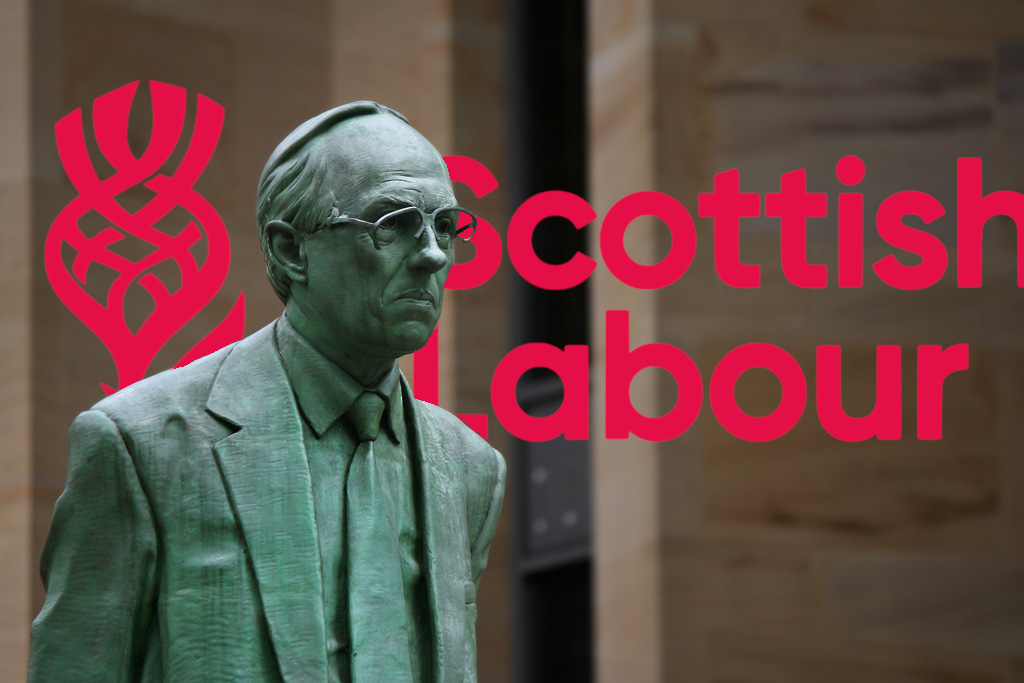
Scottish Labour no longer has giants like Donald Dewar.
Earlier this year, Scotland went to the polls in elections to the Scottish Parliament. With no party achieving a majority it is difficult to choose a winner, but there was certainly a loser: Scottish Labour.
“Anas Sarwar for First Minister” often seemed like an over-ambitious and politically hollow slogan for an entire election campaign, and there is talk within the party that it was a serious mistake. Many in the party believe that they had been over-focused on talking up the personality of Sarwar, rather than that of the Labour prospectus – though few in the party think they ever could have won at this election.
Internal anger has only risen in the party since May this year as Anas Sarwar resigned as Scottish Leader to become a Lord serving in Andy Burnham’s cabinet, having previously said that he “has no interest” in the House of Lords and would never join the chamber. The feeling in the party is that he has abandoned the Scottish Party at a time where it seriously requires leadership to rebuild after its defeat, and that he has left it in the mess of a leadership election with no preparation or fore-warning.
The good news for Scottish Labour is that there is no drama this leadership election. The bad news for Scottish Labour is that this is because the two leaders are strikingly uncharismatic and unimaginative.
So lets introduce the two candidates for Scottish Labour Leader and what sets them apart: Joe Fagan and Michael Mara. Joe Fagan supports extraction of North Sea Oil and Gas. So does Michael Mara. Michael Mara is sceptical of Gender Recognition reforms. So is Joe Fagan.
Another candidate, Monica Lennon, did not meet the required amount of nominations but would have certainly entered some political diversity into this most boring of contests. After not receiving the required nominations, she struck out calling for the two accepted candidates to “do better” and said “punching down on trans people and other minorities is not acceptable”. There is anger in the grassroots party that she did not make it onto the ballot. Her call for “a battle of ideas” does not appear to have been heeded.
As such, this contest is now between two Labour MSPs that have much in common, and whose social media outreach achieves a range of 5-20 likes a post (even Hillhead Review gets more likes than this), all in an election before only 11,000 Scottish Labour members.
This lack of talent may seem odd in a party that has produced the greats of ‘The Father of the Nation’ Donald Dewar, John Smith (do visit and see his head inside the GUU), ‘Never a Frown’ Gordon Brown, and Robin Cook (Former Foreign Secretary who resigned over Iraq).
It however goes deeper than this, and it explains why Sarwar has legged it for Westminster at the first opportunity. It is an unfortunate feature of Holyrood politics that the very ambitious will often prefer the victorian atmosphere and scheming of Westminster to the Neo-brutalist architecture of the Scottish Parliament. This is true of many Scottish Labour politicians, though even Alex Salmond the former SNP first minister found himself pining for a Westminster seat after his resignation.
But this cannot explain it all. There are far fewer greats in Westminster politics as well. It is often said there are ‘no big beasts’ anymore. Why? Perhaps we made a mistake when we broke apart our social services in the name of austerity, and so left our elected representatives to become effectively social workers answering case-work with small and non-permanent selections of staff with little time for politics of a bigger kind. Elected officials pay is very small compared to anything approaching the same level of responsibility in the private sector, and all seemingly just to receive death threats and abuse near constantly.
The Talent Problem pervades modern British politics, but it is most visible right now in the Scottish Labour Party. They will elect a bland leader, and it is unlikely to provide the new ideas or tonal shift necessary for a change in their political fortunes. There however seems a bigger problem that everyone in Scottish and UK Politics should heed.
Image credit: Donald Dewar by <p&p>photo, CC BY-NC-ND 2.0, Modifications made to composite Scottish Labour logo