During the 1928 Glasgow Rectorial Election, the Vice-President of the University Liberal Club was kidnapped by the Conservative Club. They imprisoned him on Eilean Gorm, a small island in Loch Ard, in the Trossachs, guarded by two Conservative students who kept him in a small hut. The following evening, Conservative reinforcements arrived with supplies, and owing to their car’s defective headlights decided to stay the night.
At 3am the following morning, the Liberal prisoner managed to escape his cell and escaped on the island’s sole boat, which the reinforcements had arrived in, leaving his captors marooned. He then walked four miles through the woods to Aberfoyle, and convinced a bus driver to return him to Glasgow in exchange for the loose stamps in his pocket. He returned to Glasgow University that afternoon to triumphant cheers from the Liberals, and swiftly returned to campaigning while the Conservative planned to rescue their marooned compatriots.[1]
It goes without saying that today the University and police might take a rather unfavourable view of students kidnapping one another, but in 1928 such proceedings were regarded as an ordinary feature of Glasgow University life. Indeed, in this campaign it was the Liberals who had drawn first blood, having already kidnapped two prominent members of the University Conservative Club, although one of whom was “released on parole” so that he could still play for the University Rugby Team, and was imprisoned again after the game.[2] Kidnapped office-bearers were usually treated well, and in past elections had engaged in golf or friendly drinking with their captors.[3]
The Rectorial Elections (or simply, ‘The Rectorial’, as it was generally known) were regarded as highlights of a student’s time at Glasgow, described in the 1934 SRC Students’ Handbook as a “triennial ebullition of concentrated Corporate Life and Academic Debauchery that will remain green in your memory until you are toothless dotards”.[4] Although some asserted that ‘no one really cares who wins’, nominally the contest was unambiguously partisan; in 1928 the candidates were all current, former, or prospective Parliamentarians, and the Conservative candidate was none other than incumbent Prime Minister Stanley Baldwin.[5]
The candidates were supported principally by their respective party political clubs at the university, and by various prominent politicians who attended as guest speakers, and were uniformly heckled. When prominent Labour MP James Maxton arrived to campaign, he arrived to mocking chants of “Oh dear Maxton we love you so, do we hell! Do we hell!”. His talk was then overshadowed by hecklers mocking his distinctive long black hair asking when he planned to have a haircut. When audience members cheered references to the Conservative government, Maxton replied that “they were cheering the fact that the country had a million and a half unemployed”. A student replied, “Yes, and half of them are barbers!”.[6]
A Conservative MP addressing the GUU found himself trapped by a Labour supporter endlessly making points of order, until eventually he himself was heckled into silence.[7] The President of the Scottish Nationalist Association quickly found that he could trip up guest speakers by simply asking them to explain what a rector’s job is.[8]
There were red lines for conduct; part-way through in the campaign, Conservative students broke into the Liberal Club’s Secretary’s private home with the help of a non-student intent on kidnapping him. The Liberals decried the Conservatives for “violating the sporting spirit” of kidnapping and breaking their “war agreement” outlining appropriate conduct. The Conservatives apologised, saying that the incident was “of an entirely unpremeditated nature, made in the excitement of the moment by a young and inexperienced fresher”.[9] The Liberals were unimpressed, and announced they would be ostracising the Conservatives for the campaign’s remainder, releasing two Tory prisoners they held as an expression of their unhappiness, while the Nationalists advocated an independent inquiry.[10]
The affair prompted the women of the QMU to present a petition in favouring of abolishing electoral kidnapping, and though some opposed “the appalling vision of a namby-pamby contest”, as they characterised it, the reaction was generally positive, and the remainder of the contest was kidnap-free.[11]
However, this does not mean that the campaign was uneventful. As always, the highlight of the campaign was polling day, or ‘Der Tag’, as it was known. Voting was done in-person, with the main polling station located just inside the South Front door of the Gilbert Scott Building. The four factions fought to seize control of the entrance to the polling station, so that only their own supporters might be allowed in. Blockading quickly turned to brawling, with fist-fighting students bombarded by flour, eggs, rotten fruit and fish heads. Much of this artillery was pre-planned, with one newspaper estimating that 60,000 raw eggs and barrels of rotten produce were placed on campus beforehand in preparation, and many combatants reportedly wore boiler suits to protect themselves. Amongst the fighters was John MacCormick, later Glasgow rector and one of the SNP’s founding fathers.
“Soon the grass in front of the University was transformed into a yellow and black mixture of evil smelling garbage, over which the fighting students skidded and sometimes rolled in their endeavours to rush and defend the doorway”, one newspaper wrote.[12]
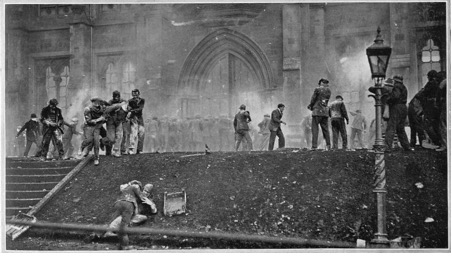
Image: Students Battle to blockade the polling station on South Front.[13]
Female students voted at a separate polling station nearby, where voting occurred without incident. According to most sources, the QMU’s women overwhelmingly voted Conservative, with Socialist and Nationalist support apparently negligible there.[14]
Ultimately, the Tory candidate won with 1044 votes, a narrow victory over the nationalist candidate on 978, followed by the Liberal and Labour candidates on 396 and 226, respectively. Glasgow’s Rectorial elections became significantly tamer throughout the 1930s, with the last publicly recorded kidnapping in 1934, and election have become far less overtly partisan since the 1940s.[15]
The Rectorial is now rarely a highlight of a student’s time at Glasgow, and turnout is far lower. There are undoubtedly many many reasons for this, perhaps the general fall in partisan loyalties across the public square, or just some people prefer to go out and vote when it’s certain you will get in a brawl on the way to the polling station.
[1] ‘Tables Turned’ Daily Record (18 October 1928), p.6; ‘Diary of a Man About Scotland’ The Graphic (27 October 1928), p.34
[2] ‘Glasgow Rectorial’ Edinburgh Evening News (16 October 1928), p.6
[3] “Kidnapped Golf” Evening News (London) (21 October 1922), p.1; ‘Kidnapping Campaign’ London Daily Chronicle (21 October 1925), p. 3
[4] Glasgow University Students’ Handbook, No. XXIX, ed. Robert Browning (Glasgow: Students Representative Council, 1934), p.85
[5] ‘Glasgow Rectorial’ Edinburgh Evening News (16 October 1928), p.6
[6] ‘Glasgow Rectorial Election’ Dundee Courier (19 October 1928), p. 9
[7] ‘University ‘Rectorial’ Sensation’ Daily Record (16 October 1928), p. 15
[8] John MacCormick, The Flag In The Wind (Edinburgh: Birlinn, 1955), p. 39
[9] ‘Tories’ Rectorial Raid’ Daily Record (17 October 1928), p.14
[10] ‘University ‘Rectorial’ Sensation’ Daily Record (16 October 1928), p. 15
[11] “No More Kidnapping” Proposal’ Daily Record (18 October 1928), p.6
[12] ‘Premier Elected Rector’ Sunderland Daily Echo and Shipping Gazette (27 October 1928), p. 5
[13] Illustrated Sporting and Dramatic News, 3rd November, 1928, p.21. British Newspaper Archive / The British Library.
[14] ‘Stage Set for Rousing Glasgow “Rectorial” To-Day’, Daily Record (27 October 1928), p.15
[15] ‘Glasgow Rectorial’, The Scotsman (20 October 1934), p. 15