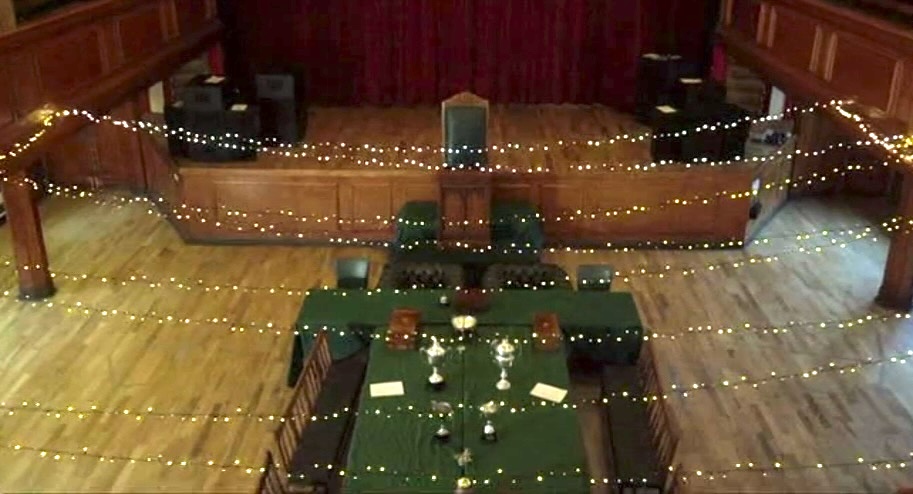
During Freshers’ Week, Glasgow University Union (GUU) hosted a debate on the Vilification of violent protests featuring prominent figures including UofG Principal and Vice-Chancellor Andrew Schofield, Politics & International Studies lecturer Michael Scanlan, Glasgow MSPs Iris Duane & Alison Thewliss, and Director for the John Smith Centre Eddie Barnes (who recently welcomed Gordon Brown to the campus) among others.
The team supporting the motion against the vilification of violent protests started strong with Iris Duane contending the failures of the democratic process while acknowledging the problem of right-wing protests. “To reject this motion would be to reject peace, protection, and our ancestors”, Iris stated in reference to the rights enjoyed today, she said were fought for by groups like the suffragettes and more through aggressive means.
As MSP Duane concluded her speech, the first speaker of the opposition, MSP for Glasgow City Council Alison Thewliss, started the debate for the opposing bench by acknowledging the differences between violence against persons and violence against property.
Her key argument was that violent protests were never effective anyway, and therefore redundant. Using the history of the suffragettes, she argued that their “violence” never did support their cause but instead alienated public support. Thewliss contended that their peaceful protests were what really led to positive reform and public support for women’s rights.
She then used examples of right-wing violent protests as a point towards the negative repercussions of glorifying violence, which set a key clash for this debate, including an extensive back and forth with examples of violent protests like the January 6 riots in America— this point specifically being brought up by John Smith Centre Director Eddie Barnes later in the debate.
The next speaker for the house was Michael Scalan of the School of Social and Political Sciences. He argued that the vilification of violent protests was a pointless exercise that did not deserve legitimacy. Again, there was a back-and-forth of examples of violent protesting leading to positive outcomes — contending that to vilify violence in protests is to ignore sacrifices made in history. He made the point that today’s “radical” may well be normal in the future.
John Smith Centre Director Eddie Barnes, who recently caught fire from student groups like the GUJPS and the Divestment Coalition for his involvement in Ex-PM Gordon Brown’s visit to the campus, who notably was the first UK Prime Minister to speak in the Knesset, and also has repeatedly reaffirmed Israel’s right to exist, insisted that violent protests can very well go wrong no matter the political cause, and that to pick and choose is a dangerous game to play. “A fist is a fist, and hammered into somebody’s face, it doesn’t matter that it’s attached to the arm of a Trump supporter, or an anti-zionist activist. It does the same thing,” he said. Eddie Barnes argued that not vilifying protests undermines “our shared democratic values” and that “violence is counterproductive”.
Notably, Michael Scalan of the House traded words with Eddie Barnes during his speech, with continued back-and-forth of historical examples.
This back-and-forth of examples of violent protests largely continued throughout the debate until it was disrupted by top UofG debater Amy Simmons. Her speech notably did not have the theme of back-and-forth’s, but instead she addressed the nuances of going by a case-by-case basis and its futility in the face of progress.
“The violence of slave owners, and the violence of slaves are not the same thing”, she says during her speech. After a lengthy debate between both sides on a topic that’s especially important in politics today, the house concluded against the vilification of violent protests, a far cry from the stance taken by the UofG’s administration, particularly in a statement in October last year, where the university said it “abhors the glorification of violence and condemns any celebration of violent acts”, shying away from non-traditional activism.
This debate couldn’t have been at a more emblematic time, as groups like the GUJPS continue to protest zionist involvement, big and small, in UofG politics, most recently at the Gilbert Scott during Gordon Brown’s visit and, more famously, the spray painting of the JMS building in November last year, though the group has had no major incidents involving violence in their protests.