Political hustings are often boring. This was an exception.
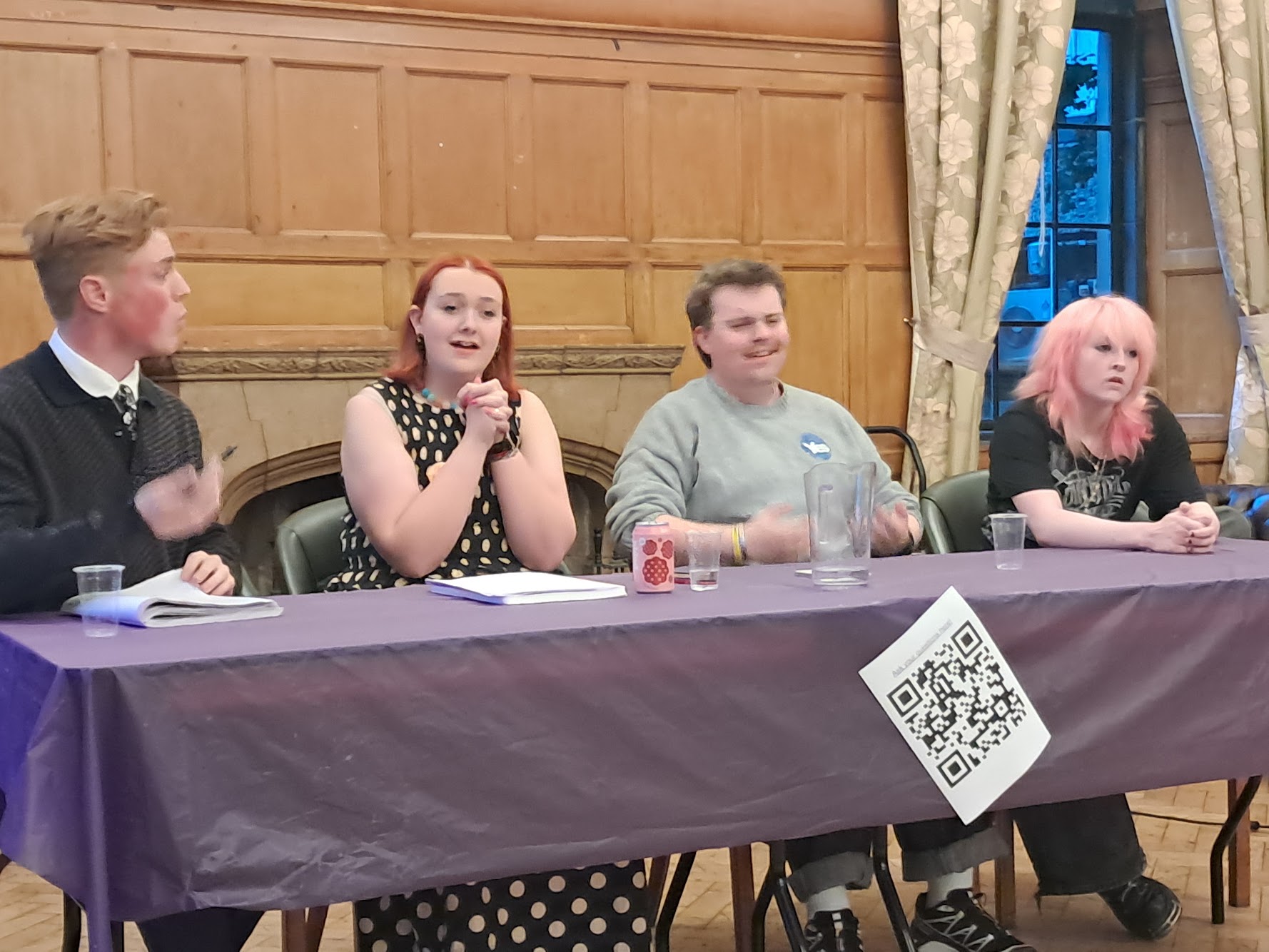
On Wednesday 16th September the University of Glasgow Dialectic Society (established 1451, supposedly, though this is doubted) hosted a hustings of the University’s political clubs, or at least four of them.
The debate was dominated by arguments over class politics, as Tory Society chair Jack Johnson defended “Capitalism as the only way a society can work” saying that “the upper class are exploited for their wealth” in contrast to what he called “the lower class”. He criticised options such as “cake-decorating and baristering” in the Scottish education system, causing an angry rebuttal from Green co-convenor Gabrielle Hogg: “Do you think that everyone should be doing Law like you do? Do you think that, what, Coffee shouldn’t exist?”. Labour Chair Amelie Burt joined in the criticism with “What is your problem with success for every child?”.
The panel was made up of the Conservative Society chair Jack Johnson, the Labour Club chair Amelie Burt, the Scottish Nationalist Association Vice-President Jason Burt, and the Green Society co-convenor Gabrielle Hogg.
The University does not have a Reform club, while the Liberal Society is in a state of limbo as two of their three committee members have graduated this year.
The first matter of contention however had nothing to do with politics but with scheduling, the event being held in the GUU at the same time as Fight Night. The queue for Fight Night was long and stretched well into University Avenue. Surprisingly, there was not a queue for the Dialectic Hustings however, who were shooed down the dingy GUU back-alley.
If you had wanted to go to Fight Night you could have got free and much quicker entry by attending the debate, a fact that was advertised on the GUU Instagram. A few attendees were conspicuous by how little time they took to watch the debate.
The debate itself started quite plainly. The Tory Chair focused his remarks on his society as being an “important place so that people can feel free to present their political views without fear of censorship”, as such being of “vital importance to the University”. In foreshadowing to the tone of the rest of the debate, he was interrupted in ridicule by others as he stood by his comments in a previous debate that “English people should have a say in Scottish independence”.
He would later say that “I am half-English and half-Scottish. I want my entire family to have a say in such a question, just as Scottish people have a say in English politics.”
“We are one country that brings all its strengths and weaknesses together. We had a referendum and we need to accept that.”
The Labour Society Chair Amelie Burt talked of their party and their prime minister bringing “tangible hope” to the people of Scotland, despite being “devastated” by their loss at the Scottish Parliament election. She pointed to her party’s rescinding of the two-child benefit cap under the “incredible Labour government in Westminster”, and pointed to how with it “we can feel things starting to change for the better”. She distinguished her party from that of her nationalist rivals by emphasising the importance of “delivery as a cornerstone of the Labour movement” which brings the “politics of real change, not grievance”.
The Vice-President of the Scottish Nationalist Association Jason Macmillan challenged back by saying “we are also about delivery” and said that they are the “champions of independnece, of Scotland’s right to choose its own self governance”. He acknowledged the party’s long stretch in power at Holyrood, and said that as such he was expecting the “brunt of questions” but pointed to the party’s record on introducing free-tuition which he said “should not be underestimated”.
“I joined the SNP because I truly believe that this is the party that delivers for Scotland. We reject Labour, especially rejecting the Conservatives and the Radical Right of Reform UK.”
The co-convenor of the Green Society decided to keep her opening remarks brief and distinguished her party with its “eco-socialist ideals that appeal to students” in the midst of a cost-of-living crisis. She pointed to the “amazing Green MSPs” that had been elected in the Scottish Parliament, including Iris Duane who became an MSP just before graduating from this university as a student. She later distinguished her party by claiming that “It is the Greens that are the only party that aren’t taking money from AI Data Centres and billionaires”, calling for the broad nationalisation of public services – “a number one priority for the Greens”.
The debate would quickly move onto a discussion on education where things would get particularly interesting. Tory chair Jack Johnson kicked things off by saying that “The Scottish Education system is not something to be proud of”, something that the Labour Chair nodded in agreement with. He said that it is ridiculous that pupils taking Highers in Scotland can choose from options including “cake-decorating and baristering”, saying that England has it “about right” with A Levels and its focus on academic qualifications – “Rishi Sunak had it [education] all right”.
This was met with anger by Green Gabrielle Hogg: “Do you think that everyone should be doing Law like you do? Do you think that, what, Coffee shouldn’t exist? This is an insane take, from a law student at the most prestigious university in Scotland.”
Labour Chair Amelie Burt joined in the incredulity: “What is your problem with success for every child?”
While the SNP’s Jason Macmillan quipped that “The great thing is that in Scotland children have options. I was not forced to take cake decorating! … I got 6 As, without Maths – that does not make me unwelcome at this university. It is elitism and absolutely ridiculous. You’ve somehow made the three of us agree!”
He also bought attention to Jack Johnson’s criticism of “Scotland’s relaxed school uniform policy”, saying that “This is the same sort of rhetoric as from Reform, you target Children, and have a go at what they wear to school.”
Talking of Reform, they were conspicuous by their absence. At a point where a panelist mentioned the lack of a Reform society, the Tory Chair muttered that “the University wouldn’t let there be one”.
The greatest moment of argument came as the panelists discussed tax:
The Tory Chair Jack Johnson criticised what he said was over-taxation of the middle and upper class. He said that “Inheritance tax makes no sense”, that such taxes are “widening the wealth divide as it affects the middle class”. He said that taxes on the wealth are especially punitive as “Millionaires and Billionaires are leaving the country … the Rich are very smart in looking after their money … What is most important is people working to get money rather than having it handed to them.”
The SNP’s Jason Macmillan shot back “What about the working class! The Baristas you so criticise!”
Jack Johnson shot back correcting the SNP chair with “Lower class.”
Labour’s Amelie Burt shouted that “you cannot call it that!”
While Green Co-Convenor Gabrielle Hogg had a question for Johnson: “So a Billionaire has earned every penny that they have?”
Johnson responded to say that they have, and that the “upper class are exploited for their wealth” as the Left “fails to understand how Capitalism is the only way for a society to work”.
Hillhead Review talked to Johnson after the debate seeking clarification on what me meant by “lower class”, he said that “upper class” is as much of a prerogative as the “lower class” term and ignores the hard work that the wealthy do to generate societal wealth. I pressed him on the idea that both terms suggest that an “upper class” is superior to a “lower class” to which he repeated his remarks on what the wealthy contribute to society.
It was a fascinating debate. Perhaps the real Fight Night was in the GUU Drawing Room.