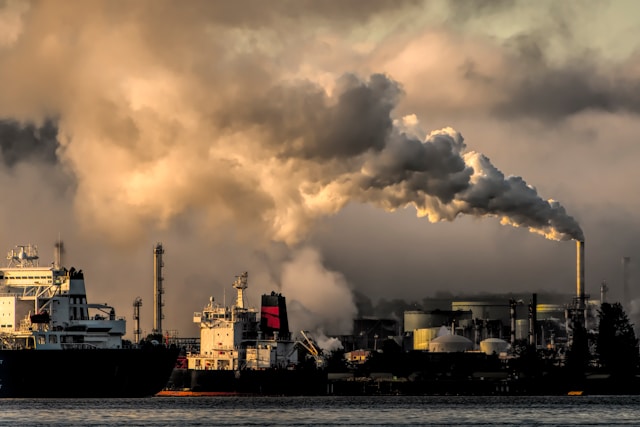
The closure of the Strait of Hormuz following US and Israeli military strikes on Iran has produced the worst oil shock since the OPEC embargo of 1973. Around 20 million barrels per day normally transit the strait – roughly a fifth of global consumption.
With shipments cut by more than 90%, 10 million barrels of daily supply have been locked behind a military blockade. Oil, as an essential good, has low price elasticity: demand does not fall in step with rising prices. People still need to cook, commute, and keep the lights on. Prices simply climb until something breaks.
Across oil-importing developing nations that breaking point is arriving fast. Southeast and South Asian economies: fast-growing, heavily reliant on imported fuel, and with limited reserves are absorbing the worst of the shock. Thailand has already moved to ration energy use.
The mechanics are straightforward and savage: higher crude prices feed directly into transport and cooking fuel costs, which account for large shares of household budgets in poorer countries. In nations where food already consumes 50 to 80 percent of income, even a 20 percent rise in fuel-linked costs means people eat less, worse or not at all.
Governments face a trilemma: let prices be and accept the fallout of inflation hitting the poorest hardest, maintain and increase fuel subsidies and blow out the fiscal deficit, or find a way off the treadmill entirely. The macroeconomic feedback loop makes the first two options progressively worse. Oil importers pay for crude in dollars, so a price spike simultaneously widens the trade deficit and increases dollar demand. This deflates local currencies, which in turn inflates the oil import bill in local terms.
But rather than simply absorbing the shock, a growing number of these economies have been leaving the game, often driven less by government mandate than by millions of households doing the maths.
Laos, reeling from the energy crunch triggered by the disruptions in the Middle East, has introduced emergency measures cutting registration and service fees for electric vehicles (EVs) by 30 percent while raising charges on combustion vehicles by the same margin. Transport companies must now ensure EVs account for at least 10 percent of their fleets by the end of 2026, and government agencies have been ordered to halt purchases of new petrol vehicles for administrative use.
This policy follows a playbook established long before the Hormuz crisis. In early 2024 Ethiopia banned all imports of ICE (internal combustion engine) vehicles and slashed tariffs on EVs. This was not a policy driven by Addis Ababa’s environmental ambitions but by the fiscal impossibility of continuing to subsidise gasoline. Ethiopia had defaulted on its sovereign bonds the previous year and received a $3.4 billion IMF bailout. The state had spent billions of dollars over the past decade subsidising gasoline for ICE vehicles. Ethiopia is well positioned to replace them as 96 percent of its electricity generation came from hydropower in 2023 alone, before the installation of Africa’s largest hydroelectric dam on the Blue Nile in 2025. In the two years since the ban, the EV share of registered vehicles is the highest in Africa at 8.3%. While Ethiopia remains exposed as 1.5 million cars still run on imported fossil fuels and the country spends around $4 billion a year on fuel imports, it is well along the path of decoupling from global oil markets, a trend likely to accelerate.
The most striking transitions are not happening through government mandate but through millions of individual consumer decisions. The solar share of Pakistan’s energy mix surged from 2.9 percent in 2020 to 32.3 percent in 2025. A quarter of Pakistani households now use solar power in some form. This was not planned in Islamabad but was built on rooftops. Households and small businesses, crushed by electricity tariffs that doubled between 2021 and 2024, began importing Chinese solar panels en masse. Pakistan’s entire grid capacity is 46.5 gigawatts as of March 2025 but in 2024 alone they imported 17 gigawatts of solar modules. The 2022 oil price spike following Russia’s invasion of Ukraine, combined with the plummeting cost of Chinese lithium-ion batteries, turned rooftop solar into an economic no-brainer for anyone who could afford the upfront cost. Now, as the Hormuz crisis sends oil prices to historic highs, those rooftop panels are paying off as millions of Pakistani households are riding out an energy shock that would have been devastating five years ago.
In war-torn Myanmar, a similar pattern is playing out under more desperate circumstances. Solar panel imports from China more than doubled in the first nine months of 2025 to around $100 million, driven by households and small businesses coping with a grid that has collapsed to 2015-era capacity amid civil war. As one resident in the Bago region put it: “It is not like we are using them for clean energy or for some environmental reasons. We are a country with civil war. We are just using them out of necessity.”
In the United States, the picture could hardly be more different. Here, the green transition is not an economic lifeline but a culture war. The Biden administration offered a $7,500 tax credit on EV purchases; after it was terminated last September, the market immediately contracted. EV sales fell 28 percent year-on-year in the first quarter of 2026, and market share has settled at around 5.8 percent of new vehicle sales. Compare that to Thailand, where EVs accounted for 19 percent of new car sales in 2025, with a spike to 48 percent in January driven by a subsidy deadline – a figure that would be unthinkable in America.
The result is an extraordinary asymmetry. Countries like Pakistan, Ethiopia, and Laos which are poorer, more vulnerable, and bear none of the responsibility for the current crisis are adapting by building new energy systems from the ground up. The United States, which helped trigger the crisis and possesses vastly greater resources, is not adapting, because it has chosen to treat the energy transition as a partisan question rather than an economic one. Developing nations are decarbonising because they must. The US is not, because it has decided it does not want to. The price of that decision is now showing up at every petrol station in America.