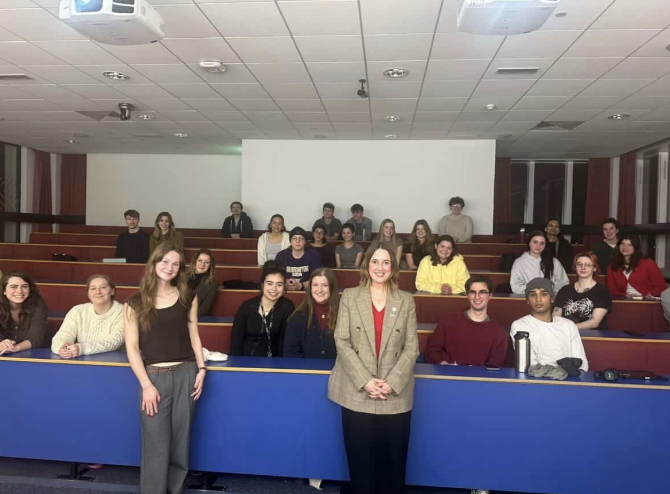
Kathryn Porter, Consul General of the United States, visited the University of Glasgow earlier this week. The event, held on Tuesday and hosted by the International Relations Society in collaboration with the British American Society and the International Law Society, focused on the work of the US Consulate in Edinburgh as well as career opportunities in diplomacy.
Porter, who is originally from Pinson, Alabama, joined the US State Department in 2007. Over the course of her diplomatic career she has held a range of postings in Europe, Africa, and the Middle East, working across political, consular, and public diplomacy roles. She assumed her current position as Consul General in Edinburgh in 2023, where she leads US engagement across Scotland.
Her visit came amid growing public scepticism in Scotland towards the United States. Ipsos polling last year found that 71% of Scots held an unfavourable view of President Donald Trump, while YouGov data suggests that favourability towards the United States has fallen sharply across Europe since the arrival of the new administration. In the UK, favourability ratings have dropped to 37%, the lowest level recorded since Trump’s first presidency.
The shift reflects a range of increasing tensions, including renewed tariff threats against European allies, concerns over escalating conflict with Iran, and widespread criticism across Scotland and Europe of continued US support for Israel’s genocide in Gaza, a characterisation established the the United Nations Human Rights Council, multiple legal scholars, and international organisations.
Against this backdrop, Hillhead Review asked Porter whether Scottish American relations were worsening.
“I don’t think so. I think that the US and Scotland still have a very good relationship. At the end of the day we’re coming at it from the point of being friends,” she said.
“We can have disagreements, but there is a desire to work together on the various positive things.”
She added that differences between governments were both normal and expected.
“I think the Scottish Government, as well as the UK Government, may disagree with the US Government, and have been open in saying that. We certainly listen. We may disagree, just the same way they may disagree when we present our ideas as well. But again, there is a general desire to find commonality and find common ground.”
Porter also addressed criticism of the current US administration from political parties in Scotland, including the Scottish Greens.
“I’m quite aware of a number of motions the Scottish Greens have introduced with their concerns about the current administration and its policy,” she said.
“If the Scottish Greens are part of the main coalition [following the election in May], that is something we would definitely try to work with and engage. We’ve had quite a good relationship with them in the past. A number of Scottish Greens have taken part in our International Visitor Leadership Program.”
Former Scottish Greens co-leader Patrick Harvie, participated in the program in 2010 which principally examined US policy on climate change.
“We would try to focus not necessarily on where we disagree, but where we can come together and reach agreement.”
Porter was also asked about concerns raised by the US administration regarding Scotland’s Abortion Services (Safe Access Zones) (Scotland) Act 2024. Vice President JD Vance criticised the legislation last year, claiming that individuals living within safe access zones had received letters warning them about praying in their own homes. He also referenced an arrest outside an abortion clinic in Bournemouth, where similar legislation has been implemented.
“The US definitely has concerns about the way it is applied,” Porter said. “It is quite interesting in the way the law is written. There has to be some kind of victim, and the question becomes who that victim is.”
She added further concern surrounding consistent enforcement of the Act.
“There have been multiple times where people have violated the buffer zones and have not been arrested, and other times they have. Some people have received a verbal warning, while others have been formally booked. It is being applied quite differently between the various devolved nations.”
According to Porter, the core issue lies in interpretation and implementation.
“Obviously, everyone accepts that if someone is violating a buffer zone and is yelling obscenities or harassing someone, that is quite clear. But when it comes to someone holding a sign or praying, the question then becomes who is the victim, who is being harmed, and how is the law being enforced.”
Scottish Greens co leader Gillian MacKay, who introduced the Abortion Services Safe Access Zones Act, publicly criticised Vance’s comments last August, describing them as “shocking and shameless misinformation.”
“The government that Mr Vance represents is a clear threat to reproductive rights,” MacKay said at the time. “He has a shocking record on abortion and many other issues. He has supported calls to reduce access to healthcare and has even argued for a national ban on abortion rights across the US. Abortion rights are human rights and they are healthcare.”
Trump’s visit to Scotland last summer was also marked by significant protests across the country. Despite this, First Minister John Swinney stressed the importance of maintaining diplomatic and economic ties with the United States.
“Scotland shares a strong friendship with the United States that goes back centuries. That partnership remains steadfast through economic, cultural and ancestral links, including of course with the president himself,” Swinney said at the time.
“As we welcome the president of the United States, Scotland will be showcased on the world stage. This provides Scotland with a platform to make its voice heard on the issues that matter, including war and peace, justice and democracy.”
He added that engagement with Washington remained central to Scotland’s international outlook, while also raising humanitarian concerns.
“As First Minister it is my responsibility to advance our interests, raise global and humanitarian issues of significant importance, including the unimaginable suffering we are witnessing in Gaza, and ensure Scotland’s voice is heard at the highest levels of government across the world.”


Leave a Reply