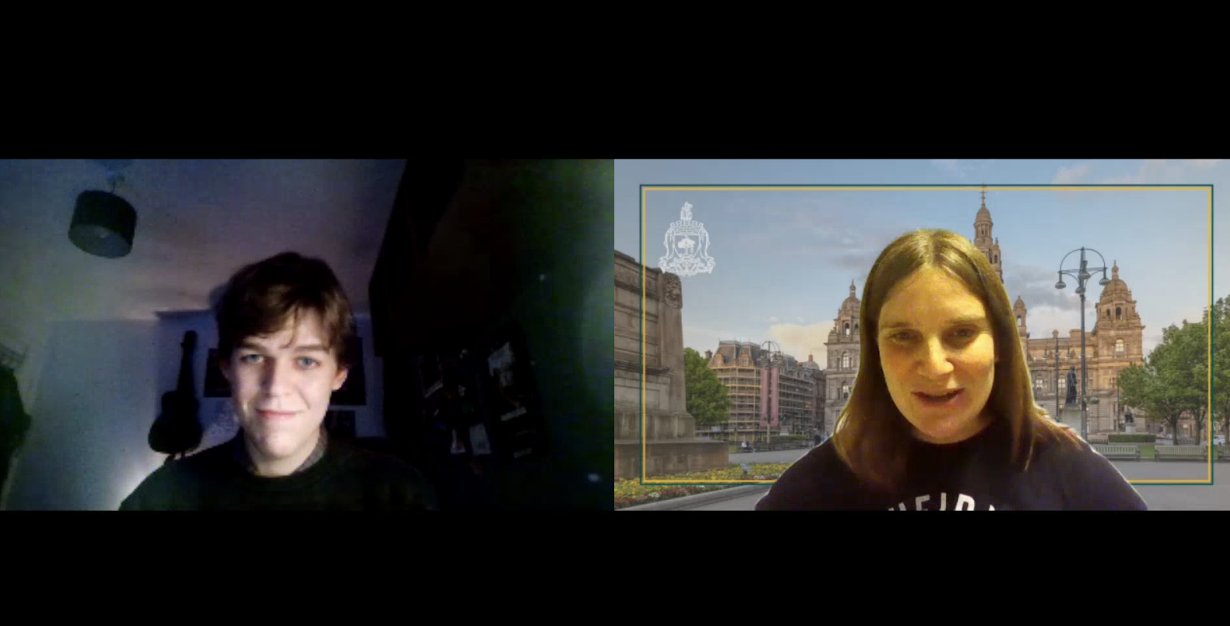
Naturally, the first part of the discussion was about the councillor’s defection and the motivations therein, where Hoy expressed solidarity with fellow Scottish Greens to Your Party defector Dan Hutchison;
“Obviously, Glasgow has always been a very socialist city and very left-leaning in comparison to other parts of the country, and we’ve been trying to pull the Scottish Greens in that direction and it didn’t go the way that we hoped it would, so we decided it was time to try something different and look to another party.”
When I asked what reason she’d give fence sitting voters to make the same shift, Hoy pointed to the excitement and potential surrounding Your Party, and mentioned the comparable difficulty the Scottish Greens have in rallying a crowd for events.
No one could disagree with the numbers, the sold-out rallies, the 50,000 members in one month, and the potential promise of building something new, from the ground up, with grassroots influence – her mention of the immediate input of her and the fellow local councillors spoke to this particularly. I’d be lying, however, if I said that the “teething problems” Hoy referred to didn’t worry me more than I‘d let on.
“As everyone knows, there have been some teething problems, but we see it very much as a grassroots movement and we’re very encouraged by what we see on a Glasgow level since we joined the party a couple of weeks ago.”
The conversation moved back towards Your Party’s socialist position, and Zarah Sultana’s differentiation of the party from England and Wales’s Greens on this issue, and Hoy agreed this was even more applicable to the Scottish Greens, referring to the Bute House agreement and potential reformation of the “coalition with the SNP,” resulting in cuts to affordable housing and local government.
“…that was one of the major reasons why we left the Scottish Greens, because we just cannot be part of that anymore.”
On the contrary, Hoy had praise for Zack Polanski and stated her decision may have been different had she been a member of the Green Party of England and Wales, with the leader’s outspoken class analysis.
It didn’t quite feel right to continually ask about England and Wales’ Greens, but I’d be disappointed not to ask Hoy’s perspective on accusations that the emergence of Your Party could split the Left vote, compared with the more unified right vote under Reform’s popularity and the Conservative party’s slow death. She seemed relaxed about this, stating that more left voices will only serve to steer the Overton window back away from Reform; disappointment in establishment parties leads people to demand change, but the form of this change is quite malleable. She referred to examples of changing minds by door-knocking, and concluded that some voters may be able to be swayed to Your Party but not the Greens or vice versa.
We moved on to discussing methods of garnering support, and agreed that the communicatory methods proven successful by the Right, with charismatic leadership and strong media presence, especially online, can effectively be adopted by left parties and figures, but Hoy suggested that usage of wider channels and promotion of diverse voices within the party alongside Sultana and Corbyn’s strong online presences could only serve to strengthen a party’s backing.
“I think it can only be a good thing communicating with different groups of people on different platforms.”
Hoy doubled down on the importance of breadth of voices when discussing what groups to target for recruitment, again referring to successes in changing minds by door-knocking and canvassing, as well as mobilising those with no intention of voting – she stressed that Your Party can appeal to current voters of numerous parties from Reform to the Greens.
“I think Your Party have a lot of the answers that people are looking for, we just need to communicate them well to people.”
We spoke briefly to the potential of Scottish independence, and I was reminded just how early-doors it is for Your Party. Hoy described a general desire for independence among Scottish participants she had spoken with, intention to voice this desire at regional assemblies and the national conference in Liverpool, and belief that the party’s eventual stance would be pro-independence, but was careful not to predict the outcome.
“I can’t pre-empt what’s going to come out of those conversations, but I would be very disappointed if Your Party wasn’t strongly in favour of Scottish independence.”
Near the end, Hoy expressed hope that Your Party could prove to be a significant electoral force by the Holyrood elections next year, but stressed the importance of local elections in 2027 and the party’s grassroots reach.
We concluded with a lighthearted question about the yet undecided name for Your Party, shared a laugh over the confusion between Your Party (the emerging Left party) and your party (the party to which you belong), and agreed the name change should come sooner rather than later.
“I haven’t actually seen the full list of options but I believe one of them is the left, and I think that’s quite strong, because it does what it says on the tin.”


Leave a Reply