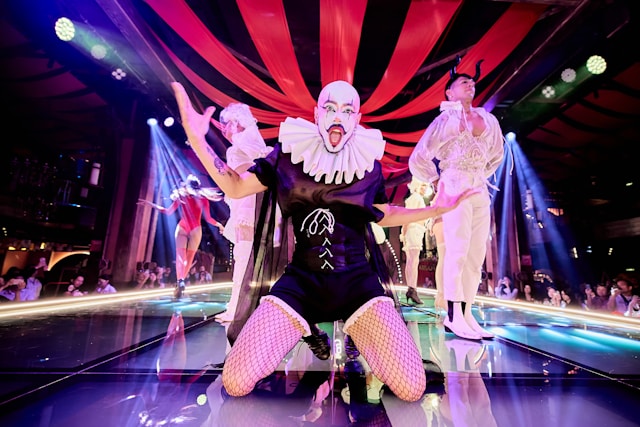
It’s a language spoken through bodies, through ornate fabrics, vibrant makeup, and movements that allow performers to articulate their identity in ways that everyday life often denies them.
For Zaym Zarif, a drag artist and photographer based in the city, drag isn’t about illusion or transformation into someone else. It’s about clarity. “Drag isn’t about illusion of becoming someone else entirely,” they explain. “It’s about exaggeration as truth.”
Exaggeration as truth cuts against many mainstream understandings of drag as a camp of excess or theatrical disguise. Instead, drag here is a method of self-authorship: a way of taking what’s already there and amplifying it until it becomes impossible to ignore. For Zaym, drag is not concealment but exposure. “When I’m in drag, I’m not hiding myself,” they say. “I’m actually closer to myself.”
This closeness to the self is not always comfortable. Drag, in this sense, is not about perfection but about permission. “Drag gives me permission to be ugly, beautiful, sexy, ridiculous—sometimes all at once.” The refusal to be legible, digestible, or “respectable” becomes a form of power. In a culture that often demands coherence and palatability, drag offers a way to exist in contradiction.
Zaym’s relationship with performance did not begin on a stage in Glasgow. It began much earlier, growing up in Malaysia, where visibility carried different risks. “That’s where my relationship with performance started, as survival,” they reflect. Performance was not initially about celebration but navigation: learning when to exaggerate, to hide, and when to adapt in order to move safely through the world. That logic of survival never disappeared, but instead was reworked.
Rather than rejecting their past, Zaym’s work keeps returning to it. “My work keeps circling that tension, what’s shown, what’s hidden, and what gets rewritten when you finally give yourself permission to take control.” For Zaym, drag is less about reinventing yourself but more about reclamation. It allows histories shaped by constraint to be re-authored on new terms, on Zaym’s terms.
Glasgow is a temple to this reinvention, not as a place that resolves questions of belonging, but a place that enables them to be articulated and expressed. “Glasgow hasn’t given me the exact answer,” Zaym says, “but it gave me language—visual, emotional, and political.” The city’s drag scene offers space for experimentation without demanding closure. Belonging, here, is not a destination. “I don’t think belonging is something I arrived at— it’s something I keep rehearsing.”
This idea of rehearsal is central to drag; each performance is responsive to its audience. It’s a space where identity can be tested, exaggerated, discarded, and rebuilt. In this sense, the art of drag isn’t about a final performance where “perfection” is chased, it’s the process— drag mirrors life itself.
Alongside performance, Zaym’s photography offers a way to hold onto what might otherwise disappear. Where drag is ephemeral, “Photography lets me hold things I’m scared of losing— my memory, the feelings, and versions of myself that might not survive otherwise.” The camera becomes a tool of preservation, capturing moments of softness and power that resist erasure. “Moments where being myself feels soft, powerful, instead of defensive.”
Yet, this work exists within structural constraints that place a burden on Zaym’s art. As an international artist in the UK, maintaining legal status and professional viability requires much more than creative output. To stay in the UK, Zaym must qualify for the Global Talent Visa, a scheme that requires international artists to prove “exceptional promise” through endorsements, press coverage, and networks. These are benchmarks that, however, disproportionately disadvantage creatives such as Zaym.
“The real challenge is having connections— something I didn’t really make as much whilst I’m in the UK,” they say.
While drag is publicly celebrated, the artists keeping it alive and dazzling often operate without the institutional backing required to remain visible and financially secure. Access to funding streams and recognised platforms becomes a deciding factor in whose work gets to be preserved and whose disappears.
Despite this, drag continues to be an art of persistence. For Zaym, it remains a way to survive and self-articulate. “Drag is a rehearsal for life,” they explain, “where I don’t have to ask permission to be who I want to be.” In a city shaped by migration and cultural reinvention, drag through Zaym’s story exposes how Glasgow’s creatives manage to persist even when the formal support isn’t there.


Leave a Reply